


Buying me a coffee (starting from £5 or purchasing a subscription helps to keep the work going and means important topics can be discussed, shared and explored. Your support is much appreciated, whether you share, buy me a coffee or purchase a paid subscription
Walking rugby is on the rise across clubs. It’s a great way to get people down to your club.
It’s also a great tool to use in coaching sessions for players of all age ranges and abilities.
Here’s some ways you can use it and adapt it:
Manage the heat of the session
There’s been a major heatwave in the UK recently. Lots of training sessions were cancelled or modified. If you’ve had safety discussions and your training session is still on then using walking rugby can be a great way to manage players in the heat.
If you’re managing the heat of the session then try using a basic level of walking rugby to start:
Players can walk with the ball
If they get touch-tackled they stop and pass the ball to a teammate
All passes must go backwards
If you’re wanting to include the game in a warm up, you can also add in activation exercises after a player has passed the ball.
Lower the intensity of contact
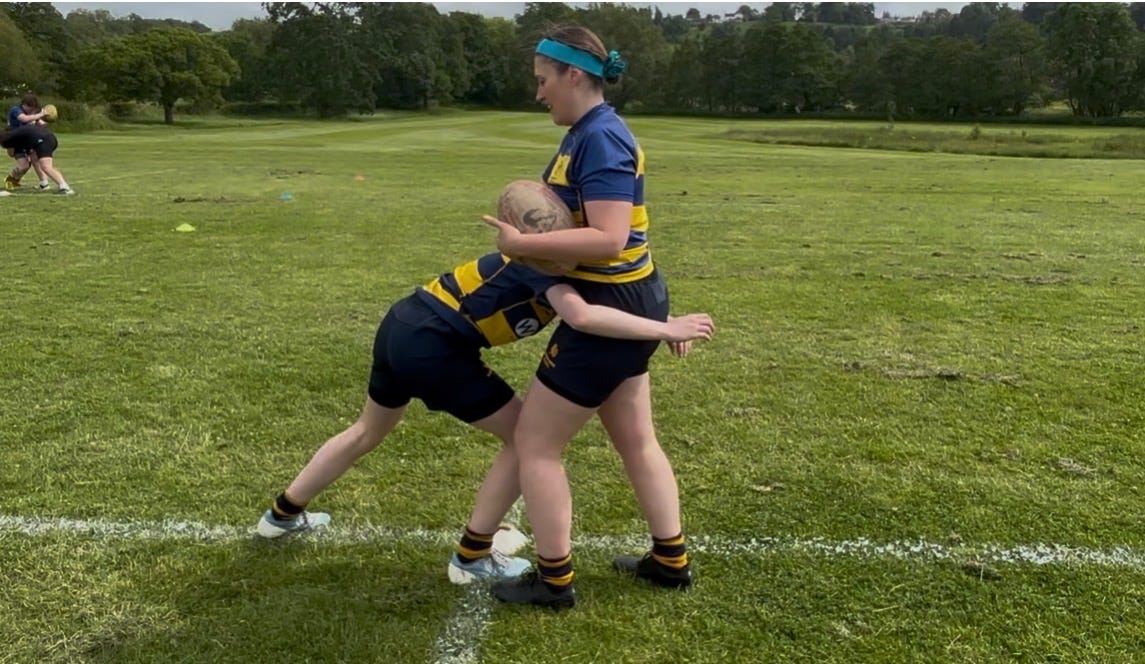
I’ve written about my approach to contact contact before and how I have used hugby.

You can also put players into a small tackle skill activity and ask them to have a walking pace to start to lessen the intensity. This allows players to build confidence as you increase the pace.
I love to use walking rugby in a game of hugby. The game tests the players ability to track and wrap a tackler as the players are moving. It’s a great way to test player’s tackle technique and it’s easily manageable from a safety perspective.
If you’re playing walking rugby hugby, here’s some ways you can level up the game:
After a wrap is complete and the ball has been passed, the tackler completes a standing tackle on the ball carrier. This lessens the intensity of the tackle whilst allowing players to tackle and be tackled.
When a player has been wrapped. The tackler releases the wrap and the ball carrier goes to ground and either presents or pops the ball. This allows the ball carrier to practice their fall and present in a game.
Focusing on a skill
One of the main benefits of walking rugby, apart from the scaled down intensity, is that it pressures players’ handling. When introducing walking rugby to players, I state this as a main benefit. This is often helpful if you have a group of players who might be skeptical to playing walking rugby.
Players cannot run onto the pass as easily when playing walking rugby. Therefore any passes thrown have to be accurate, as a team cannot rely on speed to make up for any inaccurate passes.
Try adding in the following rules to take the game up a level:
Players have to pass 5 times before they can score
A team using a loop earns a point
Teams have 2 replays each they can use if a ball is dropped
Did you know there’s a paid subscription option for Coaching Care Creativity? None of the regular content is behind a paywall so your subscriptions or coffee clicks can help keep the content going. The subscriptions are £5 a month or £50 for the year. You can also buy me a one-off coffee for just £5.
Click the links below to buy me a coffee or upgrade your subscription