


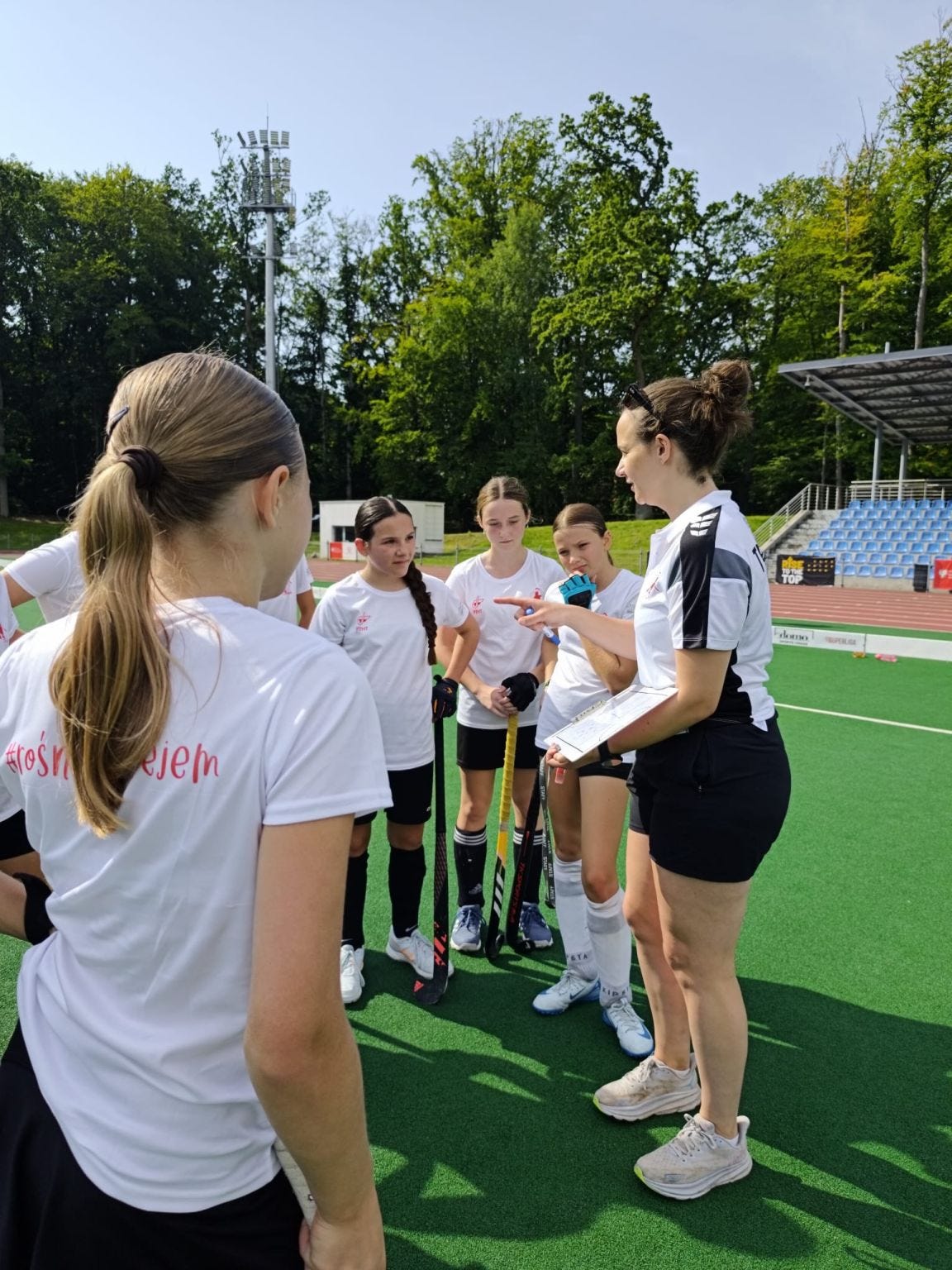
I am moving out of a full time Assistant Director of Sport role at a Girls Independent School into a Coach Developer Role with England Hockey. I am also a part time Research Assistant at Dublin City University as part of the CoEx Lab, and a Hockey Coach for both Juniors and Adults.
Relationships and building connections before training starts
Building relationships is fundamental to coaching and teaching. I make a dedicated effort to get to know players as much as I can. That includes greeting people by name and asking how their day has been.
It starts conversations with players so when it comes to talking about the game, questions don’t feel so alien to players. I tend to be a little goofy too – I enjoy humour in a session to try and make players feel at ease.
When people are getting ready for the session I try to say hello to everyone. It gives me the opportunity to gauge where people are at with their moods and energy, who might need some support and who might need some direction.
Getting opinions on practises and ideas discussed in sessions can make training collaborative. If there is something players don’t enjoy or are finding difficult, I try to find out why.
Getting to know players likes, dislikes and motivations can be really beneficial when planning activities and in the interactions we have in the sessions.
Interactions during a session
Generally, I use bigger huddles to explain the logistics of the practice, then get them into a demo and then playing as soon as I can. After a while we would then go into small groups to discuss, or I spend time with the rotating players to have conversations whilst they are between playing time.
In some sessions I might spend more time pushing information towards them to provide new information for what they are working on. Other times I will try and pull information from them to get a understanding of what they know, or don’t know, and what they are seeing during the practices or games.
I’m often with large groups during sessions, so it is really challenging to get 1-2-1 interactions with everyone from a logistical perspective. I try to mix up the interactions the players have with each other.
As I coach multiple teams I can’t always be there during matches, so they have to problem solve and communicate together without me. I try and ensure this happens in training so they build relationships between each other too, especially in environments where there is a mixed age range.
Practising their communication, clarity of messages and instruction is just as important as knowing where you stand in team moves.
Engaging a group of players in a PE lesson or training session
As a PE teacher and coach we need to understand where the players are at and respond to the needs of the group. Sometimes that means deviating away from the plan.
I’m fortunate that I have a few tricks up my sleeve so should the session deviate, I have an idea of what I can do next.
I try to consider what I need to do to make the challenge just right for players, but also where the players might be at during the session in terms of their understanding and application to the game.
Fun and enjoyment underpin everything. If we enjoy something we are more likely to put effort in engaging with it. It’s important to know players to see what they like/dislike.
Some students I’ve taught don’t enjoy competition, i.e. the winning and losing, but enjoy playing the games. Take a moment to understand the participants’ perspectives on the game/sport, rather than trying to push our own.
Some of the games we have played don’t look like the usual game, but they’ve enjoyed it and I think that is a really important stepping stone to building a positive relationship with sport and physical activity.
There will always be differing levels of understanding, technical ability and fitness. When running a lesson or training session with a mixed ability group, having multiple tricks up your sleeve is a must.
Having as many 1-2-1 or small group interactions as possible help with this. It can give you an understanding of what they understand, or don’t understand. That can help inform what adaptations you might make to scaffold the activity or set harder challenges.
I think there is also value in allowing players to watch and converse with one another to help build pictures of what the game or the skill looks like.
Did you know there’s a subscription option for Coaching Care Creativity? Nothing is behind a paywall so your subscriptions or coffee clicks can help keep the content going. The subscriptions are £5 a month or £50 for the year. You can also buy me a one-off coffee for just £5.
It sounds like Steph is doing a fantastic job creating an inclusive, welcoming and growth oriented environment for her athletes. Setting the foundation for long term health and success.