



If the training paddock is a tough place to allow silence to fall, game day is a Mario Bros big boss with lava flying around, and a rogue Yoshi making life hard.
Last essay we looked at noticing (and how stillness might help coaches) during training. Now we turn to crunch time. Stillness was still very much on my mind as I moved into the first game days of the season. They were graduated quite nicely: first, an opposed training session with an external quality side, and then an evening game at home to test some theories, player and coach alike.
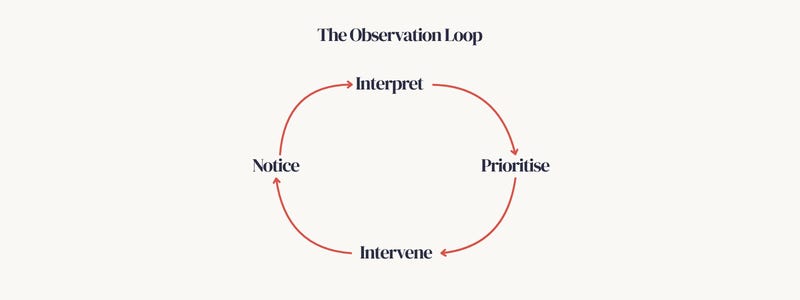
It’s easy to feel the five-minute unbroken observation we squeeze in on a Tuesday night vanishes the moment the whistle blows. Everything has a sense of urgency: it’s noisy, athletes are in a different state, and there’s a win on the line. You have your match-day squad to support, an opposition constantly trying to pull your structures apart, and a referee whose split-second interpretations dictate the rhythm of the afternoon. It’s normally at this point in the week I wish I could see from multiple perspectives at once (an excellent superpower wish, I will say).
For me, the sheer volume of energy and match-day noise used to translate into pacing the technical area or sideline (if you can get away with it). I’m sure at my first coaching club there’s still a rut in the earth where I eroded the soil on a weekly basis.
Then an old injury flared and pacing was no longer an option. Something weird happened: I noticed my thoughts were slower during a game. Now it could have been the painkillers acting as a sedative, but I preferred the thinking. I had cleaner messages as I was passing them through another player, and had less time as the team came to me to huddle up.
Once I was back and free to pace, I went right back to a high step count, high thought count, and decided it had to go.
Thanks for reading AW Coaching! Subscribe for free to receive new posts and support my work.
The quiet is in the story
A well-known technique - but one that can feel close to madness for the person muttering to themselves on the sideline - is narrating the game. It sharpens my match-day coaching threefold…
First, it allows for sharper pattern recognition. If you catch yourself saying a similar sentence a few times across a half, you notice the trend rather than an isolated mistake. I find it helps to switch between narrating only the team with the ball or only the team without it, never trying to do both at the same time.
It also zooms you out. A missed tackle reveals itself as an issue of poor field-spanning in the kick chase three phases earlier, because having a continuous story line anchors the game in a series rather than disconnected moments.
Finally, narration creates a layer of healthy detachment from the live action. I’ve never really been one to get caught up in the drama of a game day, but I certainly feel the nerves and tension rise right alongside the teams and the crowd. Running an internal commentary allows the game to unfold a little further away, turning the emotional noise into a sequence of decisions to be assessed.
I have even worn a microphone once or twice during a game and played the audio track back alongside the Veo footage in my review. It is a brilliant way to audit what you actually saw in real time, though you have to be prepared to wonder what on earth you were looking at in the heat of the moment.
Send less ripples
I think my pacing also had another consequence, in the same way my approach today does now: your players take their cues from you. Pacing will only ever be read as irritated, annoyed, or not centred in some way, in the same way leg bouncing is known as anxious or tapping points to discomfort. A rugby team co-regulates, a bench co-regulates, and you are a part of it. Holding the ship level is your role.
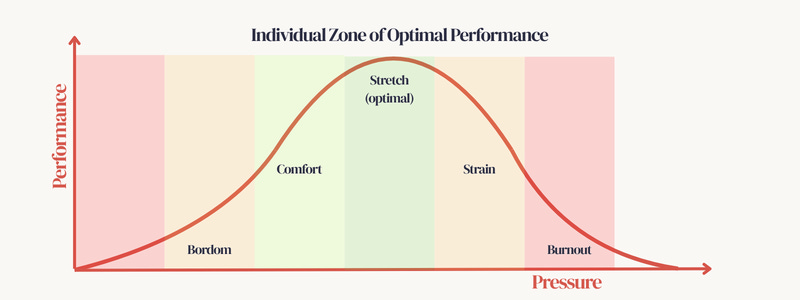
The energy we project from the technical area ripples directly into others. One of the most helpful models here for me is Yuri Hanin’s Individual Zones of Optimal Functioning (IZOF). The fly-by version is that every athlete has a distinct emotional and physiological bandwidth where their decision-making and skill execution thrive. Too hot or too cold, and the performance outcome is affected. My personal observation is that we can all influence each other’s state of readiness, meaning we must build game-day environments that create respect for these states (and their differences).
When we panic, pace, and react to every breakdown, our own visible anxiety drags players straight out of their zones, meaning they have to spend more energy (and require the knowledge) to bring themselves into optimal again. Having one eye on the energies around the coaching and playing groups, and encouraging understanding and awareness, will be key to managing match days.
Stillness offers less ripples, less disturbance (but not less care); regulating the emotional climate and meeting them with curiosity rather than more noise.
Regulating players through focus & questions
You can probably notice when a player gets caught in a loop (the repeating thought which provides comfort to a dysregulated brain). They tend to be commenting on a specific action from the game, or maybe a referee’s decision-making around one area of the game. They are no longer present; they’re playing history instead.
To guide them through to the present, John Whitmore’s GROW model becomes my friend, deliberately keeping our dialogue rooted in the ‘Reality’ phase:
“What are you noticing out there?”
“How does that picture feel to you around [X area of the game]?”
“What do you think is our opportunity now?”
Players maintain agency, and you widen the scope of their noticing, through future-focused action. It pulls their emotional focus away from external uncontrollable and gently redirects their awareness back to their own senses, their own decisions, and their own teammates.
Half-time might be positively negative
Negative space becomes crucial at half-time. Coaches and the bench have had the luxury of standing still, regulating, and having choice and space to think for 40 minutes; the 15 on the field have not.
Look around sport and you will find hundreds of examples of players saying, ‘We told the coach we needed three minutes before anyone spoke,’ ‘We spent the first five in silence,’ or ‘We had just left it all on the field and needed time to regather.’
This might go against our instincts, but we must respect the brainpower available to us:
Give them reboot time. A great time to pass round drinks and take stock of who’s in a hole. Read your players and respond in a considered way.
Use smart brevity. Huddles should be practiced in training. Athletes will have opinions and things to say; having them well-versed in communicating effectively helps. In training, if someone gives a rambling point, follow it with the question: ‘On a game day, when brain space is precious, how would you communicate that point?’
Target your input. When considering your own input, filter it: who actually needs this piece of information, and can they use it right now? If not, keep it in post-match.
Really, what we’re saying is match-day noticing doesn’t demand an answer for every phase of play. It asks instead for the composure to stay present, place a filter over the noise, and protect the space where impact happens.
Did you know there’s now coach memberships? There’s 3 tiers for coaches (or anyone who wants to support the work and wants support), there’s also a special tier for clubs and W&Gs sections. There’s a coaching hotline, access to webinar recordings, and monthly mentoring. Memberships start from £5 a month.
Thanks for sharing Jess - I wonder what to start thinking about next?!