


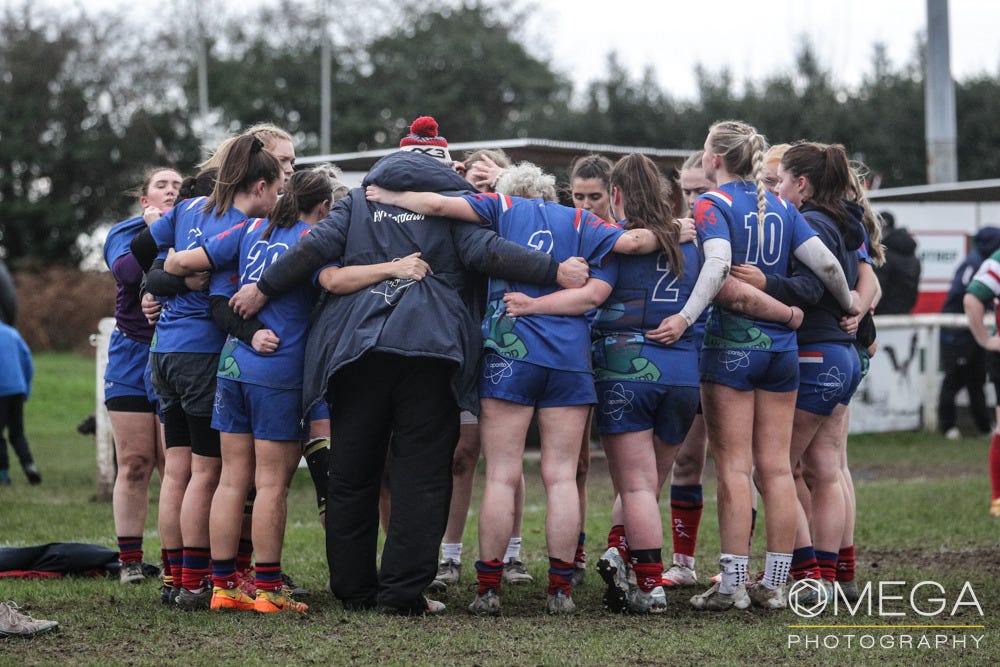
When I’ve coached adult women who are new to rugby, I’ve noticed they’ve often struggled with their confidence. This can be a combination of anxiety around learning a new sport, being in a new environment and potentially additional challenges due to going through the menopause.
It can be hard for any player, but especially those new to the sport, to identify and reflect on their progress. As coaches, we can help players believe in themselves and recognise the growth they’re experiencing.
These can come from structured and unstructured verbal exchanges we have with players. It can also happen through interactions that are player-player that we help facilitate.
These exchanges between you and the player, or player-player can be something as simple as praise. This (hopefully) isn’t a groundbreaking concept.
Reflecting together
Player-player reflections can often be more impactful, as it’s a peer recognising how a teammate has developed. This can be arranged by pairing players up to share feedback.
This could be partnering players up longer term; a newer player could be paired with a player who has a leadership role or a higher playing age. This helps newer players feel connected and supported. It also means no player is potentially left on their own in any planned or organic connection time.
You can help guide some of the reflections based on what questions you ask. This could be something like: “find a partner and share your goal for the session.”
Depending on the day the player has had, the goal could be something simple like “have fun”.
You could then prompt the partner to ask how they could support their teammate in achieving their goal for the session.
This could also link with getting players to share and support each other on long term goals. You can help facilitate this by asking them to share one long term goal, arrange opportunities for the players to have regular check ins with each other, and partner or group them on activities that directly work on their goals (for example: grouping them on a tackle exercise if one player has a contact related goal).
Goal cards
I’ve found it’s important to have something physical in order to help players track their progess. IDPs (individual development plans) are a great way to get players to share their goals.
I have often simplified this (especially for newer teams) and deliberately made them physical rather than digital. Goal cards are small paper cards. (I’ve written about them before.)

On one side, players write down 3 superpowers. These could be anything physical, mental, tactical, technical etc. Writing down these 3 superpowers helps players give themselves a confidence boost.
A player might struggle to identify 3 superpowers. I have then encouraged other players to support their teammate and tell them what they like their superpowers are.
One the other side of the card, players write down 3 ‘even better ifs’. These are things they could improve, so they would be an even better player if…
For newer players these goals might be quite broad. For example: “improve confidence in tackling’. As players develop, you can narrow the goal down to be more specific about an area of the game. For example: the connection element of the tackle.
In players that are new to the game, listing ‘gain confidence’ as a goal is telling you where the player is currently at. In reflections after this, have some chats with the player to see what aspects they might struggle with and how you can help.
When a player has achieved a goal they can physically tick the goal off on the card. For a player that has put ‘gain confidence in the tackle’, have a chat with them around how they confidence has improved.
It might be that their overall level has increased but they now want to work on a specific area of the tackle. The player can tick off their first goal and replace it with another.
This helps the player reflect on their own progress as well as refine their own goals as they develop.
Did you know there’s a subscription option for Coaching Care Creativity? Nothing is behind a paywall so your subscriptions or coffee clicks can help keep the content going. The subscriptions are £5 a month or £50 for the year. You can also buy me a one-off coffee for just £5.