


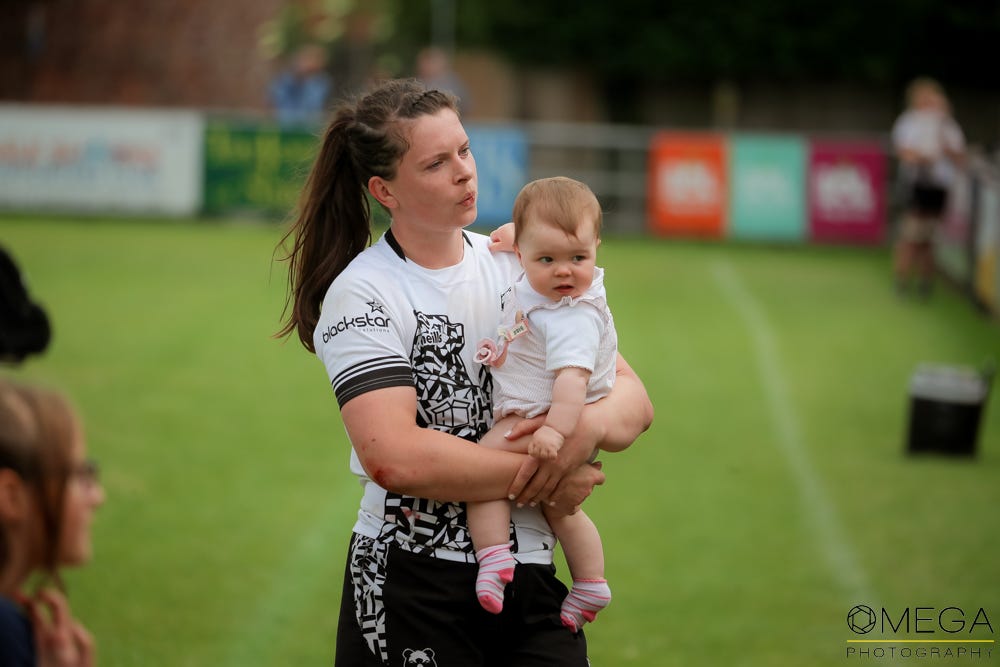
New World Rugby guidelines for postpartum players have two categories: elite and community. The guide is split into 6 phases including: recovery, review, recondition, return to training and return to play. Each phase looks at different considerations. Jo Perkins (former Head physiotherapist for the WRU women’s squad) explains more:
A large part of my background has been supporting pre and post natal athletes. When I started as head physio for the for the Welsh Rugby Union, I saw a real gap for our rugby players.
I knew some players who had returned at community level after 6-8 weeks, and had long term implications because of that. This was because there was no specific guidelines for them. Although the world of pre and postnatal care has really evolved over the years, there wasn’t anything specific for our rugby players.
With the rise of professionalism, it was inevitable that more female players will have a baby and return to rugby. I wanted to create something that was credible, current and user friendly.
I got in touch with Dr Izzy Moore, who I’ve worked with for a long time, who is exceptionally experienced in working within female health and sport and academia.
I was really excited to get something comprehensive out there with her. We approached World Rugby and met with Dr Chintoh, who leads the World Rugby Player Welfare Committee.
We had extensive chats about how we can make the guidelines accessible for all, as just because someone is elite doesn’t mean they are professional. One example is Canada, the World Cup and the crowdfunding they had to do.
We didn’t want to create something that was only achievable for a few players who are in elite and well funded programs.
We also wanted to make sure it didn’t just reflect what Izzy and I knew in the UK healthcare systems alone. They are World Rugby guidelines, so was important we had contributions from all over the world and from a variety of different professions to make these as practical and realistic as possible.
We had involvement from strength and conditioning coaches, doctors, sports medics, nutritionists, obstetricians, psychologists, biomechanists, physios and pelvic health physios. Gráinne Donnelly is one of the world leading pelvic health physios, who’s also one of the main authors and contributed heavily.
The Elite and Community Guidelines
There are two guidelines, one for elite players and one for community players. The guidelines are based on the clinical support available and accessible resources.
The elite guidlines refer to players who have a medically supervised and multi disciplinary rehabilitation program in place, access to pelvic health services funded, and access to in person, supervised rehabilitation.
The community guidelines refers to players who will need to lead their own rehabilitation processes or might have a little bit of support once a week at a club from a physio, for example, or a coach.
At the moment, due to lack of access to supervised rehabilitation and pelvic health services, the community guidelines are very likely the ones that the majority of players are going to use. Essentially, the only difference between the two guidelines is the speed of access for services, the processes of access for external services, and how much 1-2-1 support there is.
The guidelines go into different sections. We wrote it based on having a similar approach to returning from an injury. We wanted it to be really obvious that there needs to be a graded and progressive approach that was individualized.
This is very different to the previous advice for many women, which was: wait 6 weeks and then crack on. That meant so many women weren’t prepared for the demands of running, jumping, tackling and being tackled.
There needs to be a period of relative rest and recovery, which is so important for time with the baby as well for the mum. The guidelines then follow a progressive exposure to different loads.
‘Load’ is something external we are applying to the body, whether that is a movement, weights, a jump, a run, or anything rugby specific. We really didn’t want women to go from 0-100 in terms of load. That’s where many women run into trouble with things like leaking.
We split the guidelines into specific sections, and each of those sections contain six stages. Those contain specific considerations, including: the pelvic floor, the abdominal wall, breast health, mental health and nutrition. There are also birth considerations, which detail some guidance depending on type of birth that the player has or any other medical considerations.
The Pelvic Floor
The pelvic floor, for many years, has been a taboo subject. Leaking was just considered a normal and unfortunate side effect of having a baby. Now luckily, there are so many fantastic pelvic health physios and academics, and research has shown that leaking shouldn’t be treated as a normal side effect.
The pelvic floor is relevant to everybody, man, woman, postpartum or not. It is an important part of sports medicine. I think things have really changed in how we now see the pelvic floor.
However, we know that many postnatal women still don’t actually do their exercises. Up to 70% of women are not doing them well or correctly. It’s important to acknowledge that postnatally, all women have pelvic floor reconditioning needs.
The pelvic floor muscles change throughout pregnancy. They lengthen and widen and experience further stretch and trauma during a vaginal childbirth. So everyone will need some form of rehab.
In the guidlines, we highlight really specific symptoms that might mean the pelvic floor muscles aren’t functioning well, this is known as pelvic floor dysfunction.
Incontinence is one of the most common and associated symptoms, but there are other things like urgency, needing to go regularly, or not feeling like you’re able to completely open or release the bladder and bowel, feeling pressure or bulging or dragging in a vaginal area. They are symptoms which are very common for things like a prolapse, painful intercourse or tampon insertion, or even more widespread pelvic pain and back pain.
These are all associated with the pelvic floor, but many women, or healthcare professionals, don’t make that association. We wanted to highlight symptoms to raise awareness and then give specific recommendations of how to do pelvic floor muscle training.
It’s also really important that the guidelines contain details of when and where to seek help if things aren’t improving
The Abdominal Wall
The abdominal wall also goes through a progressive stretch from a growing baby over the nine months. To prepare for the impact of a tackle, trying to generate power and pushing forward in the scrum, players need a strong abdominal wall that can transmit force from their lower body to their upper body.
It’s important the player completes a graded abdominal rehabilitation program that goes beyond just a few planks or a few crunches. The guidelines also highlight symptoms, which might mean some extra help is required if anyone is experiencing them. One example is Diastasis, where there are changes in the appearance and the function of the abdominal walls.
The method of delivery will also impact the abdominal wall. A C-section is major abdominal wall surgery. The initial phase after the surgery will require different processes with wound care and watching for infection. Assisted births with forceps or ventouse will have other implications, including tearing.
It’s important that players respect that initial healing time just like they would with a muscle injury or head laceration in a game. Players and support staff need to take the same care, the same recovery tips, just like they would with anything else.
Mental Health
Becoming a mother, whilst it can be absolutely wonderful for for a lot of women, can also be a really challenging time. Mental health must be considered through postpartum return to rugby.
There are high rates of postnatal depression, anxiety and stress. Having support staff aware is important. It’s vital that staff are empathetic, supportive and nurturing.
Mental health considerations aren’t just for immediately postpartum women. Players might return to sport when they’re 6-9 months postpartum and different challenges can present.
It’s important that coaches and other staff are aware of how to get help and where to signpost players to.
Sleep is vital for all of us to function well. We all know the effects that a bad night’s sleep, and particularly two or three in a row, can have on our mental health.
Bad sleep is very common for postpartum players. Being understanding and adaptable is key. A player who’s coming in to train might not have slept properly for five days. Training with fatigue has an effect on reaction times, which can be a risk factor.
Breast Health
Breast Health is often not thought about for many rugby players in general, let alone postpartum players. Evidence has shown us the effects that breast movement can have on comfort and performance.
Having a well fitted sports bra is essential during pregnancy, the breasts undergo a number of anatomical and physiological changes as they prepare for lactation.
We should support our female players in their choice to breastfeed or not. Either way, there will be changes in soreness and shape that need support around pain management and bra fitting.
It’s vital that players get an individualized assessment. Breast shape and size will change and the sports bra will need to change as well.
There’s some good information that exists now about how to assess and fit your own bra, rather than buying a one size fits all option. A good fitting sports bra helps players be comfortable, especially when they’re going into contact.
Neurodivergency and Making the Return Individualised
It’s important that we’re addressing any neurodivergent considerations. Neurodivergent athletes are often left out of policy. It’s important to explore how to support individual players. Consider what is going to enable them for success and what the barriers are.
How the return to rugby pathway works is very individualised. However, there are some key consistent factors, when writing them we wanted to make sure that people aren’t rushing through these stages.
The return should be based on symptoms and function, as well as the healing timescales. There should be regular evaluation of physical and psychological signs and symptoms throughout each phase.
Players can regress through stages and present new symptoms. Any new symptoms should require a new assessment and might limit the progression. That is okay and it’s important to convey that to the player.
There’s loads of ways we can adapt so we can avoid jumping ahead and putting our female players into situations where they’re not ready. We don’t want women playing with symptoms or pulling out of the sport altogether.
Where possible, have a multi disciplinary approach, with the player at the center of any return to play decision making. Each player will likely enter at different points. Some women may want to start their return after just a few weeks. The Bristol Bears and England player Abbie Ward is one example.
Other women may return to the club at six months and may have only done a jog at that point. They still progress through the same stages, but they might move through an earlier phase quicker, compared to someone who has just had a baby, because they don’t have the same initial healing that someone 2-3 weeks postpartum would.
Both players, whether they’re entering at 2 weeks or 25 weeks, are still going through all the phases. Even if they’re coming back in at a year postpartum, they might have not done anything for that year.
If they jump straight into rugby without the adequate strength, conditioning, fitness and neck strength, the likelihood of them getting injured is a lot higher than somebody who’s gone through the pathway.
The final piece of the puzzle is whether the player feels ready to play. Navigating the new role as a mother-athlete is never linear. There are other considerations including: childcare, time away from home and mental readiness.
This is why the player is always at the center of the decision making. Just because they’re physically ready, doesn’t mean they’re necessarily ready to play. Essentially, that comes down to the player and the coaches. If the player doesn’t look confident in sessions, their return can take a little longer.
Coaches can support the players and being aware of this process is a really brilliant step. Knowing that there are different phases and the challenges that can present for women throughout those phases will promote empathy. The player will feel valued and supported.
The player still needs to feel like an athlete. Being a rugby player is a huge part of so many women’s identities. Clubs supporting players so they can be both player and mum is vital.
The checklist at the end of the guidelines is there to stop anyone rushing through each phase. It addresses things like: has the player had a bra fit, are they asymptomatic, have they achieved certain strength markers?
The strength markers will look different, whether you’re in the elite or the community setup. In the elite setup, you might have things like force platforms and fancy testing. However, if you don’t have access to those, there’s other ways we can test strengths, such as gym markers and endurance testing.
It’s making sure those have been ticked off, rather than someone returning to running and jumping, when they still can’t really do many squats or heel raises without pain or leaking.
It’s all about putting the player’s health at the forefront, rather than rushing into playing.
View the RFU community guidelines
Did you know there’s a subscription option for Coaching Care Creativity? Nothing is behind a paywall so your subscriptions or coffee clicks can help keep the content going. The subscriptions are £5 a month or £50 for the year. You can also buy me a one-off coffee for just £5.