



The Beginning
It does not take long in the coaching realm to find a discussion on values, or more specifically, an exercise on values. Sitting within the ‘understanding self’ - part of the ‘understanding self, understanding others, understanding the game’ trilogy - it’s value (you’re welcome) it’s not up for debate. My values shape how I see the world, and therefore what I naturally encourage in my presence, which in turn affects how I approach my coaching craft.
Now, ‘understanding self’ is more frequently framed as self-awareness. Self-awareness is presented as a process, a journey on the way to mastery of holding a better perspective.
The same is not true for values work, despite the comparisons in the work. Instead, this is often delivered more binary; as if fixed in space and time, more of an innate compass, waiting to be labelled.
Most of us, as coaches, will have engaged in CPD which asks us to circle our values on a list and weave them into our coaching philosophy. Some will have been asked to list our values (with reflection).
Better workshops may ask us to debate with others what values we think are most important of a list - this at least creates dialogue and debate. I have even seen exercises list statements (like ’doping should be allowed in sport’ and then, in a magazine flow chart style to convert said statements into prescribed values (autonomy vs cohesion).
It’s like ‘What care-bear are you?’ but for coaches.
A word on words
Firstly, these are often words not naturally in my vocabulary. You won’t catch me using the word ‘openness’ but arguably it does describe the way I appreciate people who embrace learning. As it doesn’t sit in my natural word deck, it fades from my mind quickly.
To help with this, once I did these exercises. I have started explaining them out loud to a critical friend (or my long suffering partner). In the explanation, I’d often find more naturally aligning words, which more effectively sat in my brain. A step forward. A step which sits in Seth Godin’s sentiment “you talk to find your voice, you don’t define your voice to start talking”.
Using words within easy reach of my brain helped, but I was sitting recently in one such CPD trying to recall what I had said the last time I was in such a room and decided there must be a better way. I didn’t want to have a list of values to talk about, I wanted them to walk the walk.
You can be other things
Another step forward for me happened when I stopped trying to capture all of me in a list of three. Maybe this is obvious to the rest of the world but having failed more concussion baselines than I care to count I knew a list of 6-8 values was not for me. I am however, human, and a complicated one at that; capturing all I value in 3 words prevented me from capturing any of it.
Once I stopped trying, and accepted I could value plenty more outside the list, I found the process a lot less stressful. To decide what was included I went with frequency items, what governed most decisions I make most as a human? (spoiler; it’s almost always which path holds more learning opportunities).
Now my coaching philosophy for the longest time has been joy and puzzles. I make sure I create the opportunity for both in every session, or room I contribute too.
Yes, I have some possible solutions, but really I should be setting really good puzzles, and nothing is worth going after without Joy. It does not demonstrate all I am as a coach, nor all I value in session design, but it does help me evaluate sessions, and helps co-coaches know me and how I function.
Did you know there’s now coach memberships? There’s 3 tiers for coaches (or anyone who wants to support the work and wants support), there’s also a special tier for clubs and W&Gs sections. There’s a coaching hotline, access to webinar recordings, and monthly mentoring. Memberships start from £5 a month.
Experiment 626; stitch-ing values into action
Still, I felt there was more to be done. Even with the extra steps, the values work still felt abstract. I had no proof they were present, or correct, in my day to day.
Which led me to think about how I could more closely align my values to action. Yes, I could ask my players, but again, I’d face a different word deck, and I am the only person with a complete picture of me (minus the occasional blind spot).
At this point, I posited a question to myself. Scientists test theories all the time: What if we thought of the values we generate at the end of these CPD sessions as a hypothesis?
Take yourself back to school science. You make a prediction, construct a test, and see if what you expect actually happens on the ground. Then, you reflect deeply on what resulted in the difference. Maybe we could encourage the exact same discipline in coaching.
Curious to see if I was right about myself (whilst fully acknowledging my own confirmation bias) I decided to see if I could prove they walked the walk. Here opens the experiment on values that live on the grass: Project Walking Values.
The starting point:
Tracing back my actions directly through my reflections. Part two will include my experiments and how I want to test my prediction.
The values I started with:
Joy, Intentionality, community.
These values are made for walking
I started by noticing a shift in how we label self-awareness as a constant lived process, and values work as coaches.
This more often looked like a labelling workshop which we then just continued along our way with. Above, in the first part, I explored this difference and I laid the challenge to myself to explore it more actively. What follows is that exploration.
It is important here to stipulate: this is an experiment of my coaching values - the experiments would look different for an environment’s values (pt 3 pending?).
I had a starting point of joy, intentionality and community. These values had come about from repeated classroom sessions reflecting on my values, but between these sessions I rarely reflected on them, and almost never recalled them without checking my notes.
The walking values project was to change that abstraction. To fold and make my values visible every day, be extracting them from evidence, rather than selecting them from a sheet.
First, I looked to use words which were my own. It’s tough to remember language you don’t reach for every day. Then, I stopped trying to fit all my values into the words I labelled. I gave myself the grace to be other things also.
Third, I decided to find the values from the data, rather than a printed list in front of me. I love to run experiments in my coaching, trying different approaches and ways of adapting, so project walking values was born. Part two follows the experiments I went through and the values which got spat out.
A word deck to suit
Firstly, to ensure I was allowing myself to spot relevant values - not just the three I was looking for - I built a values list which came from me; my word deck, rooted in my knowledge. I went for a diametrically opposed process, when I wrote ‘curious’ I wrote ‘decisive’ next, I tried to balance all words to allow for both sides of the scale. While there are infinite ways to describe what we do, I wanted a rigorous framework to look at and bounce off of, aiming for a truly comprehensive list.
Now, I started this entire process with Joy, Intentionality, and Community. But I immediately struggled to think of a clear, non-abstract way these words would actually show up on a pitch.
That friction forced me to transmute my values into doing words:
Joy became joyful actions, Community became connecting, and Intentionality became detailed (then concise), deliberate delivery through actions I could spot in data.
Next, I utilized Artificial Intelligence (Gemini, as I am a self-confessed Google fiend) to stress-test a different iteration, backed by the sciences of psychology, pedagogy, and coaching, I asked it to provide a list of values not covered by this list which you may find in a coach. Also explicitly asking that it did not assign a ‘good’ or ‘bad’ to any value.
What it produced was useful to check and challenge my own thinking. (I often find AIs role most useful when playing devil’s advocate, as then you cover a completely different view to your own).
What came out were 16 values, and my own definition of them, which I believe are present in coaching craft:
As I am fully aware there is some rogue application of words in this initial set, these definitions were vital to keep me grounded.
Experiment 1 - Notebooks are receipts
I, like many, have a habit of keeping coaching journals. My immediate reflections on sessions are often not detailed enough. So they are backed by a mandatory weekly date with my notebooks, where I write freely about my practice. It might cover how a session left me feeling, what specific friction I faced, and where the plan went sideways. It has left me with a growing library of personal data.
For the first test, I went back through months of my own work. Every single time I saw clear text evidence of one of the 16 behaviors, I tallied it. After all, the notebooks show where my attention is, and ‘where attention goes, energy flows’ (James Redfield and the Makia principle).
Next, I noticed through my entries that when I moved more towards the value of curiosity, I was far less prescribed in my approach.
Curious would look like solving an athletes dilemma together, prescriptive would look like I am searching for prepared coaching points to add to the space.
To help acknowledge this, I shifted the list into two columns, indicating the scales:
Buying me a coffee (starting from £5 or purchasing a subscription helps to keep the work going and means important topics can be discussed, shared and explored. Your support is much appreciated, whether you share, buy me a coffee or purchase a paid subscription
Experiment 2 - Video is the critical friend
Next, I utilised another tool at my disposal, and gulped as I did, I am trying to develop the habit of watching & hearing myself coach. I say trying because, frankly, hearing my own voice on tape gives me the “ick” more than I care to admit. As a result, I have plenty of chest cam footage clogging up my computer storage.
So, I booted up the laptop and watched it once again. This time, noticing when I presented my values. This was not easy - much cringe was endured.
Everytime I noticed it I marked it on the tally, making notes to add some depth (including writing different values and seeing if they were a more applicable value to explore). Slowly racking up reps of walking the walk of my value.
I also have access to SAM at the moment through coach logic - an AI tool to categorise coaching interactions - it was surprisingly helpful to review specific tools, such as what kinds of questions I ask, which revealed I might impose more than I am responsive.
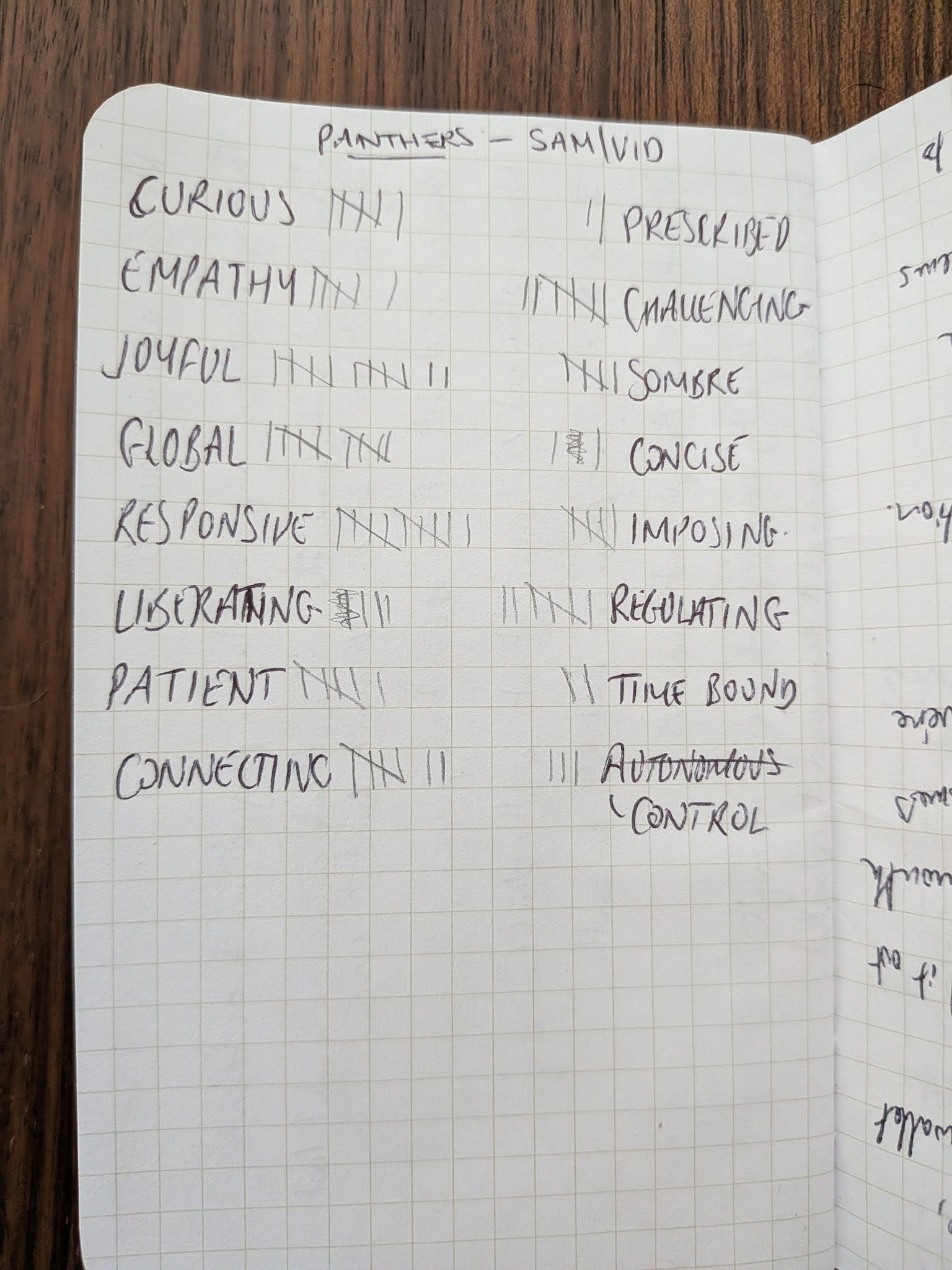
It was during this video review that the word deck underwent a shift.
First, Autonomous officially became Controlling. Watching the tape, I struggled to choose whether a behavior pointed to autonomy or liberation.
My original definition (‘holding the reins of control myself’) didn’t match autonomy well. It was more about keeping the chaos down by keeping myself at the wheel, or Controlling; which balanced perfectly against Connecting.
Second, Concise changed to Focus, because I realized that keeping an intervention short doesn’t automatically mean you hit the developmental sweet spot.
Experiment 3 - Valuing a new habit
Now, one of my aims amongst this was to get better at working more actively with my values. To do so it needed continuous practice.
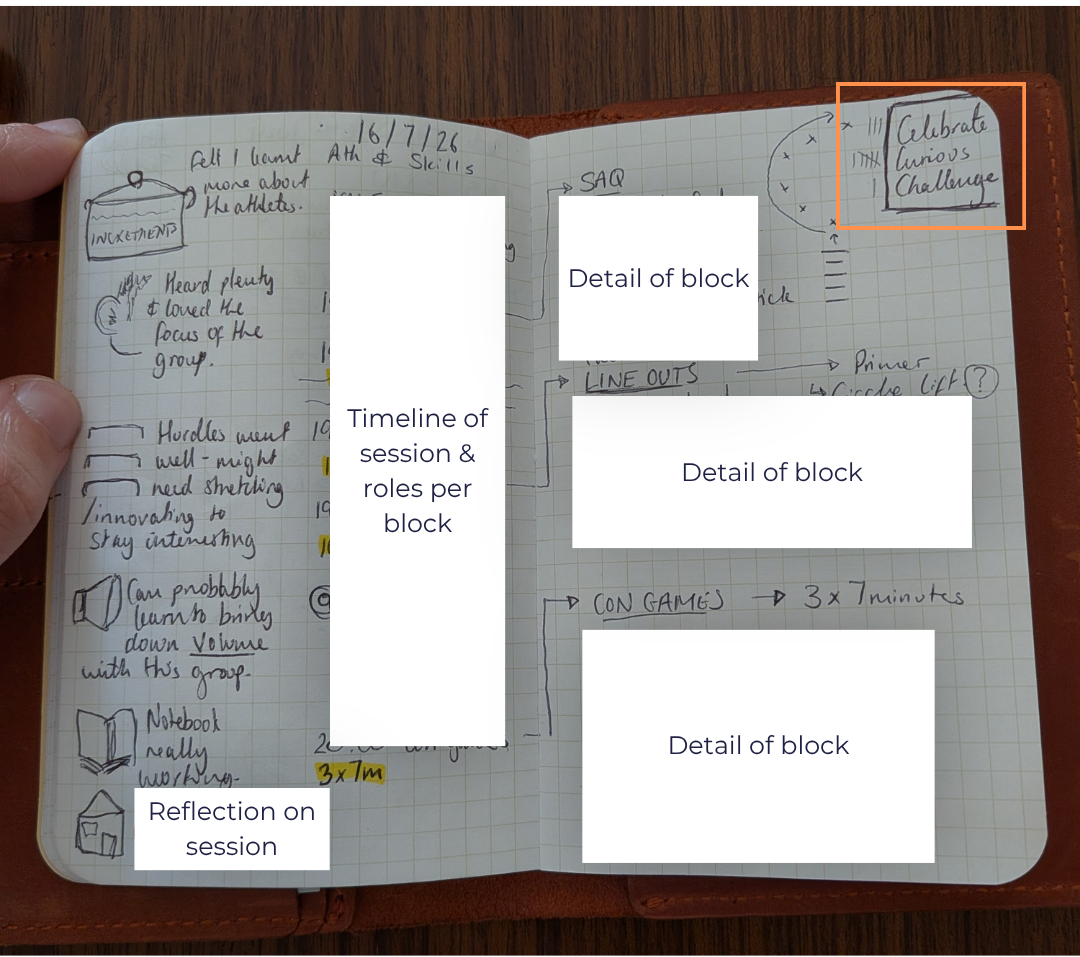
I printed out the two-column value scales onto small pocket sized tables (altering Joy to Celebrate - as it more accurately labelled what action I displayed). I do my hot reflections in field notes A6, books.
At the end of sessions, I began drawing a line marking where my behavior fell along each spectrum that night. Some sessions leaned toward one value, sometimes another.
For example, I would sit high towards Liberating in a session about finding confidence coming into the pre-season. Other times the session required me to be unapologetically Regulating - showing the way.
I also started writing my values in the corner of my pitch side notebook - and tallying the example. This helps me notice whether I’m aligned today. Below you will see a recent version. It is very quick (though some sessions it’s less used than others!).
Challenge is low in this example, but I am learning a new group, so I this value might not be actioned while I prioritise learning their languages and the values of the group.
Funnily enough, I began to realize that the values I actively lived had a massive tendency to morph whenever I was under stress. Whether it was a lack of sleep, too many hours driven on the motorway, or simply being irritated like a mutant alien dropped on a desert island without a high human population. More evidence I am not one thing.
Eventually, after tracking across many sessions, the patterns emerged. Three repeat heavyweights arrived as the consistent pillars of my actual, lived practice:
Celebrate, Curious, and Challenging.
Approaching problems curiously, celebrating people, and challenging for improvement.
These values were made for walking
So, was the cringe worth it?
100% - I have my three values written in my coaching notebooks and on my session plans. They’re used when I introduce myself to a new group:
“Hi folks, I’m Amy, I know I am new to you and everyone coaches differently so what you will see from me
I love to celebrate skill, sometimes I might add a score to a game for someone trying a really cool skill, even if it didn’t come off in that moment.
I am curious about how we solve rugby problems together, so I might ask a lot of ‘what if we?, or how might we? Questions
I also love to see improvement, so I might move the rules of games a lot, to try to stretch and challenge us, or I might ask you for another level of detail on an answer, for the same reason.”
Practical, lived values, which walk the walk.
What have I learnt:
Walking values are infinitely more valuable than those on a page.
Did you know there’s a paid subscription option for Coaching Care Creativity? None of the regular content is behind a paywall so your subscriptions or coffee clicks can help keep the content going. The subscriptions are £5 a month or £50 for the year. You can also buy me a one-off coffee for just £5.
Click the links below to buy me a coffee or upgrade your subscription