



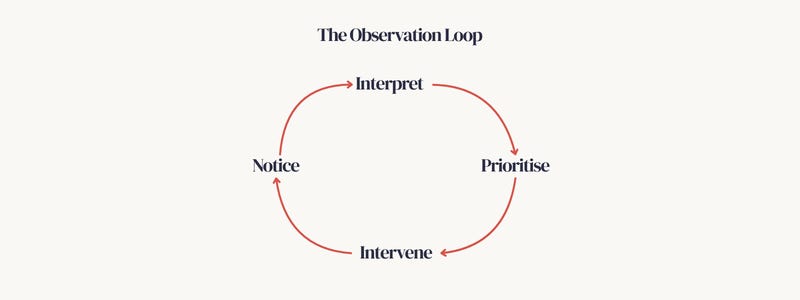
I am beginning to think coaching is its own constraint based game. There are endless rules & systems to expose athletes to, and we are trying to do it all in a constant race against sun-baked ground, player availability, and every other challenge we stand before. We make thousands of decisions about what to prioritize - what to intervene on.
So much so, that sometimes I wish I had picked a sport with less moving parts, athletics maybe, where we guide one athlete through their day or darts, where there is less at play to watch. This essay explores what it means to ‘notice’ on a training field, and why it’s a skill which needs conscious development in coaches of all kinds.
Now, a word to the side before we begin…Coaching faces a new dilemma. While data is an embedded part of our game (thanks money ball), AI pitches new levels of gadget and gizmos; all offering to offload some of our noticing into cold hard stats. A tempting prospect which should be considered in full before it’s a route we travel down.
Now, coaching is a three step when we consider train field coaching. A never ending cycle of interpreting, prioritizing, and intervening. In doing so, we place the spotlight on our baseline ability to notice. If we fail to spot that our fly-half is approaching the game without kicking, we won’t prioritise what’s going on & it will result in a missed intervention. If we don’t notice, we won’t coach.
Recently, someone asked me what I look at in sessions, essentially asking what my framework for noticing was. I greeted the paradox like an old friend (thanks Brené Brown). Frameworks (while useful and to be celebrated) can be rigid, linear, and prescribed; placing blinkers on as we go through a model. I reflected that noticing asks of us a different approach. It requires wayfaring: a willingness to drift, to let go of the checklist, and to respond to the session as it unfolds. The paradox being that the more tightly we cling to a rigid model of what we expect to see, the more we develop blind-spots. The aim is less solving the paradox and more holding the tension.
Bias
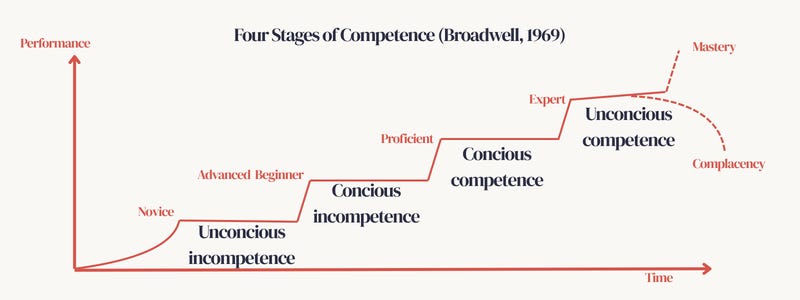
The balance is made harder by the way coaches arrive with a history, a bias. For at least sections of the game, they will sit within Martin Broadwell’s unconscious competence step of mastery (image below). Here, observation has become intuitive. For example, I called lineouts in my playing career, I now see where the opposition are likely to throw to without much internal struggle. Critical as a player, but as a coach? I now have to catch that feeling and then explore what it is exactly that I am reading, to enable me to coach it. Actively dredging up why I know that in order to explain it to someone else. A part of my history which changes how I approach problems.
When considering my frameworks for noticing, I lean instead on a different model. I use an intentional filter for each session. If the group is focusing on attack, the bulk of my attention sits in that domain; defensively, players might receive far less feedback in that session. As long as the curriculum is balanced over time, players will develop rounded and smoothly.
At the same time, I am holding Individual Development Plans (IDPs) in my peripheral vision. I will happily pull my attention away from our primary theme if a develop moment pops up right in front of me for an athlete working on a specific personal goal. In my setting, we share these IDPs, so I only have a small number to notice.
Present & Correct
Now, I mentioned noticing sits under coaching as a base skill, but if we ask what skill is behind that again (Sakichi Toyoda’s ‘five whys’) To notice any of this, we have to be present enough to see. We have to learn how to stand amongst the patterns.
Intervention makes us feel useful. But every time we rush to provide an immediate solution, we stop players recognising the consequence in real time too (which is the only feedback they would have on the pitch), we must balance allowing them to experience the environmental feedback, with wanting to accelerate their learning.
Stillness
I have been in Premiership offices while people tear about the place, it’s a normal part of the language. Sport moves quickly, so it’s easy to get picked up in the speed. Instead I’d challenge you to go to one of the top restaurants in the country at service time and see what you can spot. Dinner is game time for chefs. If you’ve gone to a good enough restaurant you will see stillness (the french laundry’s chefs table on Netflix works well if you’re intrigued, without the price tag of fine-dining).
As a chef, you know it’s going well if you put a plate down too loudly & the whole dining room turns towards you. Everything is set up to notice the details of the plate before you. Maybe rugby can take a noticing leaf from a brigade.

Observation is not a waiting to give instruction. It is an active discipline. It is stepping back from the chaos and resisting the urge to jump in, so the pitch can reveal the lesson. In the dining room, it looks a little different. Negative space on a plate: the space on a plate with nothing allows a dish to look cohesive (imagine the elements on the below plate all plated smushed together). There’s a calmness to the plate that comes from the gaps; it allows the diner to see the elements and understand the dish far better than if it were one solid mass.
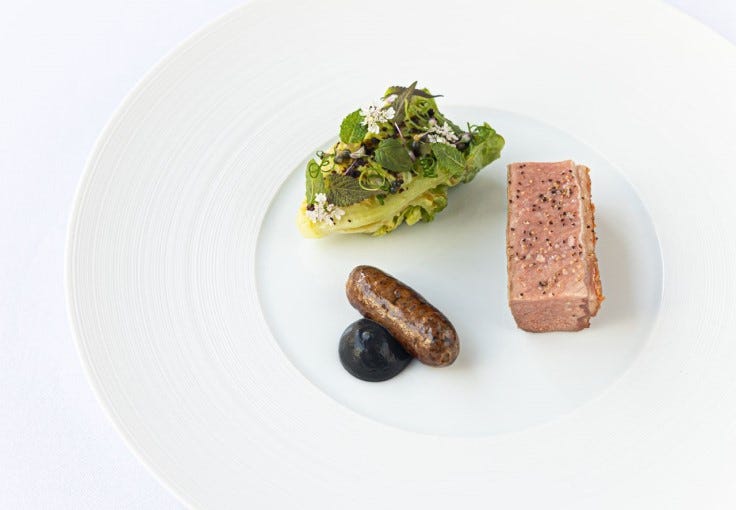
Stillness on the training field is our negative space. It gives the session its clarity. A tool to be chosen, just like ‘pause’ ‘replay’ & questioning. When we stop filling every second with interventions, we give our athletes the room to feel the consequences, make the mistakes, and create their own understanding. They get to wayfare too.
Our ability to consciously tune in to noticing is key to increasing the quality of the information we work from. Betting information means better action. But how does that ability to be still survive when the pressure multiplies, the pace accelerates, and the stakes shift to a game day?
Did you know there’s now coach memberships? There’s 3 tiers for coaches (or anyone who wants to support the work and wants support), there’s also a special tier for clubs and W&Gs sections. There’s a coaching hotline, access to webinar recordings, and monthly mentoring. Memberships start from £5 a month.
Really enjoyed this one - though I certainly slip out of low gear & get caught up in the game more than I should!